

 Tweet
Tweet
Polite Canadians? Yeah, sure
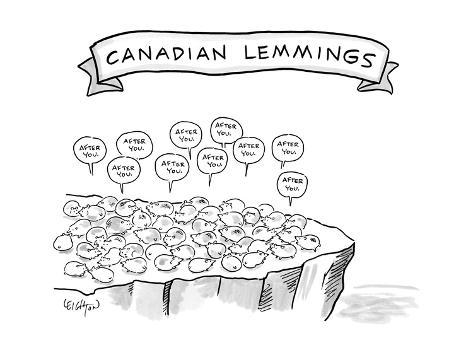
Lovely cartoon in the New Yorker this week. Dozens of lemmings heading toward the edge of a cliff. Each has a little speech bubble over its head reading “After you.” The caption is, of course, “Canadian Lemmings.” It seems we are still famous for our politeness.Or maybe the lemmings are being devious: Each wants the others to go off the cliff but hopes to linger a while him- or her self. Nothing wrong with being last in line when the queue is for cliff-jumping. But that’s likely a reaction only a Canadian would have. The cartoonist, Robert Leighton, was born in Long Island (and in 1979, as a teenager, according to Slate magazine, was the last contestant on the long-running TV game show, To Tell the Truth). Foreigners are likely to go with the uncomplicated cliché.
The lemmings bring to mind another national cliché, namely that if you step on a Canadian’s toe, he or she says “Excuse me.” Reading the British philosopher Roger Scruton’s 2000 book England: An Elegy, I learned we actually got that from Britain. He claims the same anecdote/parable for the pre-60s England whose passing he regrets, England before the yobs took over. If the Royal Family has any role in setting an example of good behaviour, well, continued power to them. Of course, some may have to up their game a bit in order to do so. (Not mentioning any names, Harry.)
There is a view in economics that free markets promote politeness and civility. I was listening to two Americans describe the virtues of markets a few weeks ago, one of them noting that at the end of a market transaction both parties say “Thank you” because both parties benefit. I had to interject that in Canada we say “Thank you” even if we lose. We never do forget, however. Our telecom companies seem to be finding that out as they try to rally support against an allegedly unfair increase in competition from Verizon. The ground doesn’t seem to be swelling in their favour.
My own favourite telecom/politeness story concerns the reaction of the Bell Canada agent on the other end of the line when we phoned to cancel our regularly interrupted Internet service (in favour of Montreal-based Videotron, owned by Quebecor). After about 20 minutes of over-the-phone paperwork to complete what you might think would be an easy transaction, the agent signed off with “Thank you for choosing Bell.” Well, of course, the point was we weren’t choosing Bell. We were choosing Videotron. In this case, the motivation was probably reflexive corporate rote rather than inherent Canadian politeness.
When young I thought our national reputation for politeness was disappointingly underwhelming. Better the drama, dash, flamboyance and self-centred self-confidence of the Americans — another national cliché that is far from true, many Americans being very well-behaved, despite Jersey Shore and other depravities currently on offer on reality TV.
But with passing decades and declining testosterone levels, I think more and more that a society known for its civility is mainly to be admired, even if it may be dull, as indicated by that fictional but iconic headline: Worthwhile Canadian Initiative.
Is it true, though? Are we Canadians really that polite? Has Robert Leighton ever been to a hockey game? When hockey players say “After you,” like as not they’re inviting their opponents into the boards in preparation for elbowing them or worse. How is it that the world’s most polite people love the world’s most boisterous sport?
Not all hockey players are Canadian. But the roughest and least polite are. Granted, they do seem to operate according to a behavioural code, a sort of “Marquess of Don Cherry Rules”: You remove your helmet and visor before fighting (though odds are you don’t wear a visor). You don’t sucker-punch a guy. You don’t hit him when he’s down. You don’t show him up if he’s lost honourably. If it has been a good, clean fight you congratulate each other from your respective seats in the penalty box. There clearly is honour among thugs. But precious little politeness. You’ll never mistake it for Sweden.
Come to think of it, has Robert Leighton recently observed our politics, which are becoming more and more like our hockey? In the line of duty I receive a regular email from one Dan Hilton, executive director of the Conservative Party of Canada. After Liberal Leader Justin Trudeau mused openly about legalizing marijuana, a reform this newspaper proposed 15 years ago under the editorship of the late Neil Reynolds, Hilton’s email delivered the equivalent of a cross-check to the kidneys. “Support strong leadership — and stand up against Justin Trudeau’s plan to bring more illegal drugs into our communities.”
Well, so far as can be told from scrum comments, unlike the drug dealers Hilton’s language evokes, Trudeau doesn’t actually plan to bring “more illegal drugs” into our communities — just one currently illegal drug whose illegality many millions of Canadians consider inappropriate. Moreover, it probably isn’t one of his “top policy priorities.” And even if it were, holding a view that finds support in many places, including several U.S. states, shouldn’t be considered proof “that he does not have the judgment to be Prime Minister.”
If we were the polite Canadians foreigners think we are, we would now proceed to a civil and informed discussion of the merits of liberalizing our drug and alcohol laws (can’t we please, please bring other provinces’ wines home to drink?). But those who are in charge of the lemmings on our various parties’ backbenches seem unwilling to allow that to happe
The lemmings bring to mind another national cliché, namely that if you step on a Canadian’s toe, he or she says “Excuse me.” Reading the British philosopher Roger Scruton’s 2000 book England: An Elegy, I learned we actually got that from Britain. He claims the same anecdote/parable for the pre-60s England whose passing he regrets, England before the yobs took over. If the Royal Family has any role in setting an example of good behaviour, well, continued power to them. Of course, some may have to up their game a bit in order to do so. (Not mentioning any names, Harry.)
There is a view in economics that free markets promote politeness and civility. I was listening to two Americans describe the virtues of markets a few weeks ago, one of them noting that at the end of a market transaction both parties say “Thank you” because both parties benefit. I had to interject that in Canada we say “Thank you” even if we lose. We never do forget, however. Our telecom companies seem to be finding that out as they try to rally support against an allegedly unfair increase in competition from Verizon. The ground doesn’t seem to be swelling in their favour.
My own favourite telecom/politeness story concerns the reaction of the Bell Canada agent on the other end of the line when we phoned to cancel our regularly interrupted Internet service (in favour of Montreal-based Videotron, owned by Quebecor). After about 20 minutes of over-the-phone paperwork to complete what you might think would be an easy transaction, the agent signed off with “Thank you for choosing Bell.” Well, of course, the point was we weren’t choosing Bell. We were choosing Videotron. In this case, the motivation was probably reflexive corporate rote rather than inherent Canadian politeness.
When young I thought our national reputation for politeness was disappointingly underwhelming. Better the drama, dash, flamboyance and self-centred self-confidence of the Americans — another national cliché that is far from true, many Americans being very well-behaved, despite Jersey Shore and other depravities currently on offer on reality TV.
But with passing decades and declining testosterone levels, I think more and more that a society known for its civility is mainly to be admired, even if it may be dull, as indicated by that fictional but iconic headline: Worthwhile Canadian Initiative.
Is it true, though? Are we Canadians really that polite? Has Robert Leighton ever been to a hockey game? When hockey players say “After you,” like as not they’re inviting their opponents into the boards in preparation for elbowing them or worse. How is it that the world’s most polite people love the world’s most boisterous sport?
Not all hockey players are Canadian. But the roughest and least polite are. Granted, they do seem to operate according to a behavioural code, a sort of “Marquess of Don Cherry Rules”: You remove your helmet and visor before fighting (though odds are you don’t wear a visor). You don’t sucker-punch a guy. You don’t hit him when he’s down. You don’t show him up if he’s lost honourably. If it has been a good, clean fight you congratulate each other from your respective seats in the penalty box. There clearly is honour among thugs. But precious little politeness. You’ll never mistake it for Sweden.
Come to think of it, has Robert Leighton recently observed our politics, which are becoming more and more like our hockey? In the line of duty I receive a regular email from one Dan Hilton, executive director of the Conservative Party of Canada. After Liberal Leader Justin Trudeau mused openly about legalizing marijuana, a reform this newspaper proposed 15 years ago under the editorship of the late Neil Reynolds, Hilton’s email delivered the equivalent of a cross-check to the kidneys. “Support strong leadership — and stand up against Justin Trudeau’s plan to bring more illegal drugs into our communities.”
Well, so far as can be told from scrum comments, unlike the drug dealers Hilton’s language evokes, Trudeau doesn’t actually plan to bring “more illegal drugs” into our communities — just one currently illegal drug whose illegality many millions of Canadians consider inappropriate. Moreover, it probably isn’t one of his “top policy priorities.” And even if it were, holding a view that finds support in many places, including several U.S. states, shouldn’t be considered proof “that he does not have the judgment to be Prime Minister.”
If we were the polite Canadians foreigners think we are, we would now proceed to a civil and informed discussion of the merits of liberalizing our drug and alcohol laws (can’t we please, please bring other provinces’ wines home to drink?). But those who are in charge of the lemmings on our various parties’ backbenches seem unwilling to allow that to happe







Comment